
When an overcurrent or short-circuit strikes a power distribution system, the ability to isolate the fault within milliseconds determines whether equipment is saved or lost, whether an arc flash escalates, and whether downstream operations grind to a halt. Among the protection devices available today, the vacuum circuit breaker (VCB) has become a cornerstone technology for medium-voltage networks. But what actually happens inside that sealed bottle when it clears a fault, and why does a vacuum make such a difference? This article dissects the working principle, component architecture, and selection considerations for vacuum circuit breakers — so you can evaluate them on their engineering merits, not on marketing claims.
A vacuum circuit breaker is more than a switch in a vacuum. Its ability to extinguish an arc reliably, tens of thousands of times, rests on three tightly integrated subsystems.
Vacuum interrupter (the sealed envelope) – The hermetically sealed ceramic or glass bottle that houses the contacts and maintains a vacuum pressure below 10⁻⁴ Pa. Because free electrons have almost no gas molecules to ionize, the dielectric recovery speed after current zero is exceptionally fast.
Contact assembly – Usually made from copper-chromium (CuCr) alloy for high arc-erosion resistance. A butt-type or axial-magnetic-field contact geometry forces the arc to stay diffuse rather than constricting into a single hot spot, minimizing contact wear.
Operating mechanism – Spring-charged or magnetic-actuator mechanisms that provide the mechanical energy to separate the contacts at high speed and then reclose them when commanded. The mechanism’s reliability directly determines the VCB’s mechanical endurance, often rated from 10,000 to 30,000 operations.
Understanding how these elements work together clarifies why a VCB’s “ratings” on a data sheet translate into real-world performance: for instance, the choice of contact material influences the breaker’s short-circuit interrupting capability, not just a test certificate number. For a closer look at how different interrupter designs impact arc extinction performance and lifecycle durability, you can explore the engineering behind vacuum interrupter configurations in dedicated product series.
According to IEC 62271-100:2021, the international standard for high-voltage switchgear and controlgear, vacuum circuit breakers must demonstrate consistent dielectric behavior across a full operating cycle, including rated short-circuit making and breaking tests. This standardized test regime confirms that a vacuum interrupter can repeatedly clear faults at up to 52 kV without relying on external arc-quenching media.
Most users understand that a circuit breaker “opens” the circuit. The real question is: how does it stop an arc that can reach several thousand degrees Celsius, inside a tiny bottle, without oil, gas, or a blast of air?
Here is the sequence, broken into four stages:
Contact separation – When the operating mechanism drives the moving contact apart from the fixed contact, the current continues to flow through an arc that forms instantly across the minuscule gap.
Metal vapor arc formation – The intense heat vaporizes a tiny amount of contact material, creating a localized plasma of metal ions and electrons. Because the vacuum is nearly particle-free, the arc medium consists solely of this vapor — no background gas to sustain it.
Current-zero extinction – In alternating current, the current naturally crosses zero twice per cycle. At that instant, the vapor condenses onto the contacts and the surrounding shield within microseconds. Without new ionization sources, the arc cannot re-strike.
Dielectric strength recovery – The vacuum gap regains its insulating capability almost immediately, far faster than in air or SF6. This rapid recovery prevents voltage re-ignition, even for capacitive or inductive loads.
Why does this matter for your installation? It means a VCB can handle frequent switching — for example, capacitor bank duty or motor inrush — without cumulative gas leakage or gradual oil contamination. The arc time is typically half a cycle (around 8–10 ms at 50 Hz), which limits the energy let-through and reduces stress on connected equipment.
When selecting a medium-voltage circuit breaker, you inevitably face a technology choice. The following table compares vacuum circuit breakers with the two other common types, focusing on characteristics that influence total cost of ownership and operational risk.
| Criterion | Vacuum Circuit Breaker (VCB) | SF6 Circuit Breaker | Air Circuit Breaker (ACB) |
|---|---|---|---|
| Arc quenching medium | High vacuum (no gas) | Sulfur hexafluoride (SF6) gas | Atmospheric air (often with arc chutes) |
| Typical voltage range | 3.3 kV – 40.5 kV (extendable to 84 kV) | 3.3 kV – 1100 kV | Up to 1 kV (LV) and limited MV applications |
| Greenhouse gas impact | None (vacuum is inert) | Extremely high (GWP 23,500) | None |
| Maintenance of quenching medium | Virtually maintenance-free (sealed for life) | Periodic gas pressure checks, refilling, leak monitoring | Arc chute inspection, filter replacement |
| Mechanical endurance | High (10,000–30,000 operations) | Moderate | High (air is abundant, but contact erosion is larger) |
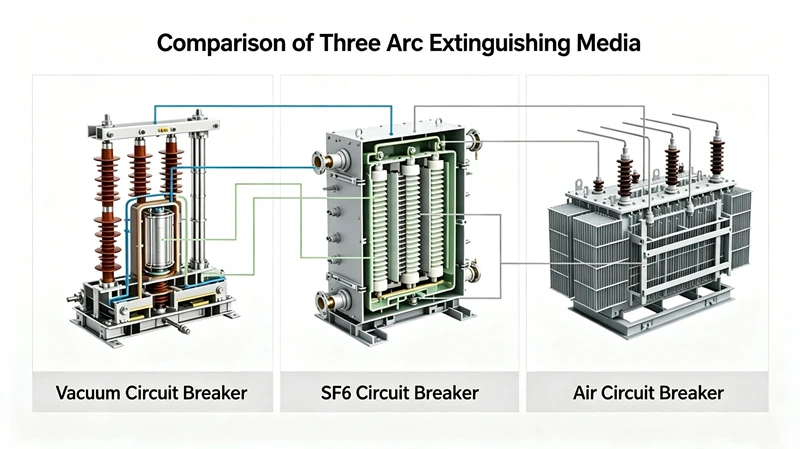
External reference – The Intergovernmental Panel on Climate Change (IPCC) Fifth Assessment Report identifies SF6 as the most potent greenhouse gas, with a global warming potential approximately 23,500 times that of CO₂ over a 100-year horizon. Stricter regulations on SF6 handling and reporting are pushing industries toward vacuum and clean-air alternatives, particularly for new medium-voltage installations.
This shift is not just about environmental compliance. For any facility tracking its carbon footprint — data centers, university campuses, light rail substations — the elimination of gas inventory and mandatory leak checks directly simplifies operational overhead.
The technological characteristics translate into a clear fit for certain operating environments. Consider two scenarios:
Scenario A: Frequent switching in an industrial plant
A manufacturing line with multiple large motors (e.g., compressors, extruders) cycles loads several times per hour. Here, a VCB’s high mechanical endurance and minimal arc erosion are essential. Look at the rated operating sequence (often O–0.3s–CO–15s–CO) and electrical endurance at rated current — this tells you how many full-load interruptions the breaker can handle before contact replacement.
Scenario B: Protection of transformers and capacitor banks at a renewable energy substation
Solar and wind farm collection grids operate with variable loads and frequent switching due to cloud transients or curtailment. The ability to reliably clear capacitive currents without restrikes (which can generate damaging overvoltages) is a key selection criterion. Here, look for class C2 or C1 restrike performance according to IEC 62271-100 and rated capacitive switching current.
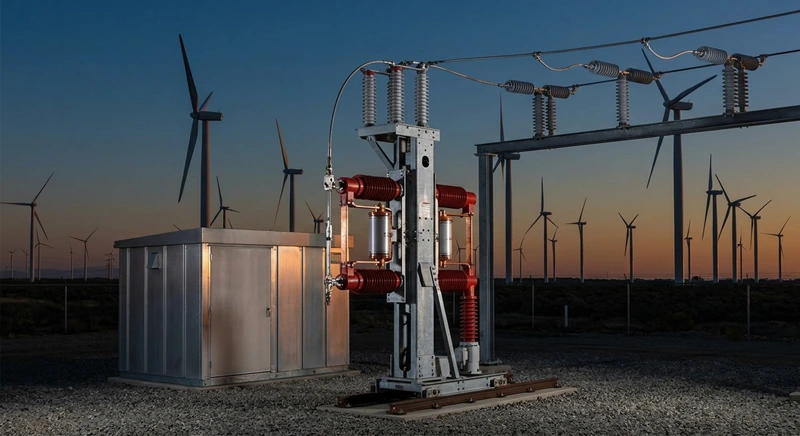
For a deeper understanding of how vacuum switchgear integrates into these specific power system architectures, you can examine real-world substation layouts and application notes for renewable grid integration.
Instead of comparing catalog numbers immediately, begin with a requirements checklist that aligns with your operational context.
System nominal voltage and insulation level – Match the VCB’s rated voltage (Ur) and rated lightning impulse withstand voltage (Up) to your network. For 11 kV systems, a 12 kV rated VCB is typical, but verify short-duration power-frequency withstand values.
Rated short-circuit breaking current (Isc) – Calculate the maximum prospective fault current at the installation point. Choose a breaker with a rated short-circuit breaking current higher than this value (common ratings: 20 kA, 25 kA, 31.5 kA, 40 kA).
Required mechanical and electrical endurance – If the breaker will perform frequent operations, prioritize models with higher endurance classes (M2 class for 10,000 mechanical operations, E2 class for extended electrical endurance).
Ambient conditions – Although vacuum interrupters are sealed, the operating mechanism and insulation housing must withstand temperature extremes, humidity, and pollution. Look for testing according to IEC 60068 environmental standards.
Integration with protection relays and SCADA – Modern VCBs can include auxiliary contacts, trip coil supervision, and communication modules. Clarify which signals your protection scheme requires before specifying accessories.
Once you have clarified these decision factors, comparing the specific specifications of available options becomes the logical next step. You can evaluate high-endurance vacuum breaker series for heavy-duty switching applications or review compact, standardized models designed for straightforward secondary distribution — always matching real needs to proven performance data. For a more detailed walkthrough on matching breaker ratings to system studies, our practical guide to medium-voltage switchgear selection offers a step-by-step methodology.
Can a vacuum circuit breaker be used for DC applications?
Standard vacuum circuit breakers are designed for alternating current (AC) systems because they rely on the natural current-zero crossing to extinguish the arc. For direct current (DC) applications, artificial current-zero circuits or special DC-rated VCBs are required; applying a standard AC VCB to a DC circuit will not interrupt the fault safely.
How do you test if a vacuum interrupter has lost its vacuum?
The most common field test is a high-potential (hipot) test applied across the open contacts. A sustained voltage hold-off at the rated test level (typically 75–80% of the factory value) indicates good vacuum. If a breakdown occurs inside the interrupter at a much lower voltage, vacuum integrity has likely been compromised. This test should follow manufacturer guidelines and relevant standards to ensure safety.
What is the typical service life of a vacuum circuit breaker?
Service life is defined by both mechanical and electrical endurance. The mechanical components can last 10,000 to 30,000 operations (M2 class), equivalent to 20–30 years under normal switching duties. Electrical contact life depends on the interrupted current; a VCB may interrupt its full rated short-circuit current several tens of times before contact replacement, and thousands of times at rated normal current.
Do vacuum circuit breakers require regular maintenance?
The vacuum interrupter itself is sealed for life and requires no maintenance of the quenching medium. However, the operating mechanism, auxiliary switches, and insulation surfaces do need periodic inspection. Typical tasks include cleaning insulating parts, lubricating linkages, checking contact wipe and opening speed, and performing a vacuum integrity test every 2–5 years depending on duty and environment.
What is the difference between a vacuum circuit breaker and a vacuum contactor?
A vacuum circuit breaker is designed to interrupt both load currents and high short-circuit fault currents, and it incorporates protective relaying. A vacuum contactor is a switching device rated primarily for making and breaking load currents at high frequency, and it must be backed up by fuses for short-circuit protection. Contactors emphasize extreme electrical endurance at normal load, not fault-clearing capability.
Are vacuum circuit breakers safe for indoor installations?
Yes. Because the arc is confined inside the sealed vacuum interrupter, there is no hot gas exhaust, no flame, and no release of pressurized arc-quenching medium. This makes VCBs inherently suitable for indoor metal-clad switchgear in commercial buildings, hospitals, and data centers, provided the switchgear enclosure maintains proper insulation distances and personnel safety clearances.

 English
 Pусский
 Español