
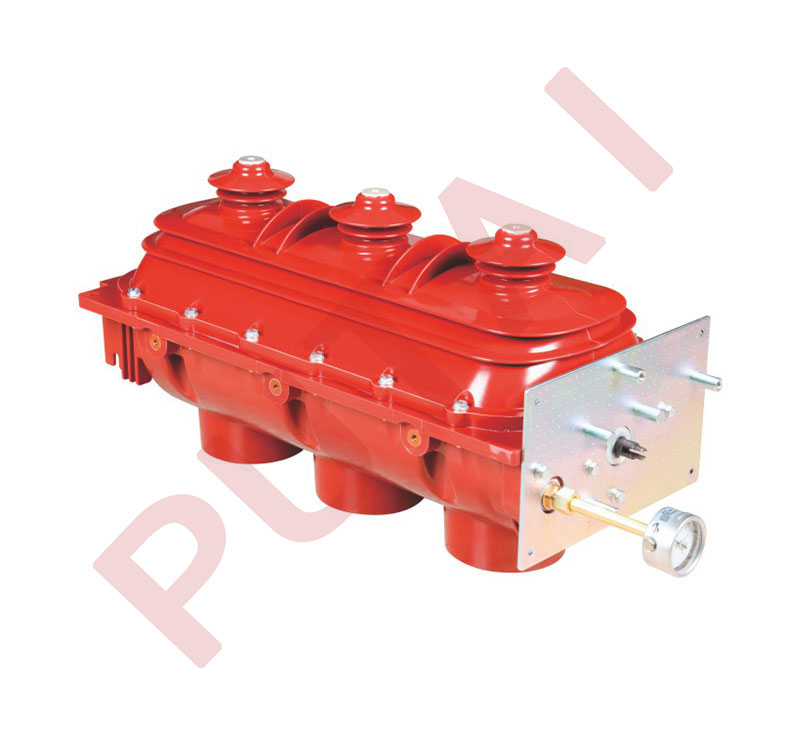
The FKN12A-12D pneumatic load switch-fuse combination unit employs a sophisticated protection philosophy that leverages the distinct strengths of its two main components. This integrated approach ensures rapid fault clearance while maintaining simplicity and economy. Understanding this protection principle is fundamental for engineers responsible for distribution network design and coordination.
Under normal conditions and during minor overloads, the load switch handles all switching operations, capable of safely making and breaking currents up to its 630A rated continuous current and specified active load breaking current. It is designed for frequent operation within its 2000-operation mechanical life. When a significant overload or a short-circuit fault occurs on the downstream network, the protection task is transferred to the current-limiting fuse.

The fuse is the primary protection element for high-current faults. With a rated short-circuit breaking current of 31.5kA, it operates in milliseconds, clearing the fault before the current can reach its full peak value. This current-limiting action significantly reduces the destructive energy delivered to the fault, protecting downstream cables and transformers. A critical aspect of the design is the impactor mechanism. When a fuse blows, its striker activates the impactor, which mechanically trips the load switch in all three phases, preventing single-phasing.
This coordinated action provides three-phase tripping automatically upon a single-phase fuse operation. This prevents the highly damaging condition where a transformer or motor continues to run on two phases, which can lead to severe overheating and rapid failure. The rated transfer current (1200A) defines the boundary where the coordination between the fuse's time-current curve and the switch's ability to handle lower faults is optimized. Putai also supports customization and the supply of related medium-voltage accessories to meet system integration needs. For expert advice on protection coordination, contact our engineering team.
(Article content references network resources.)


 English
 Pусский
 Español